
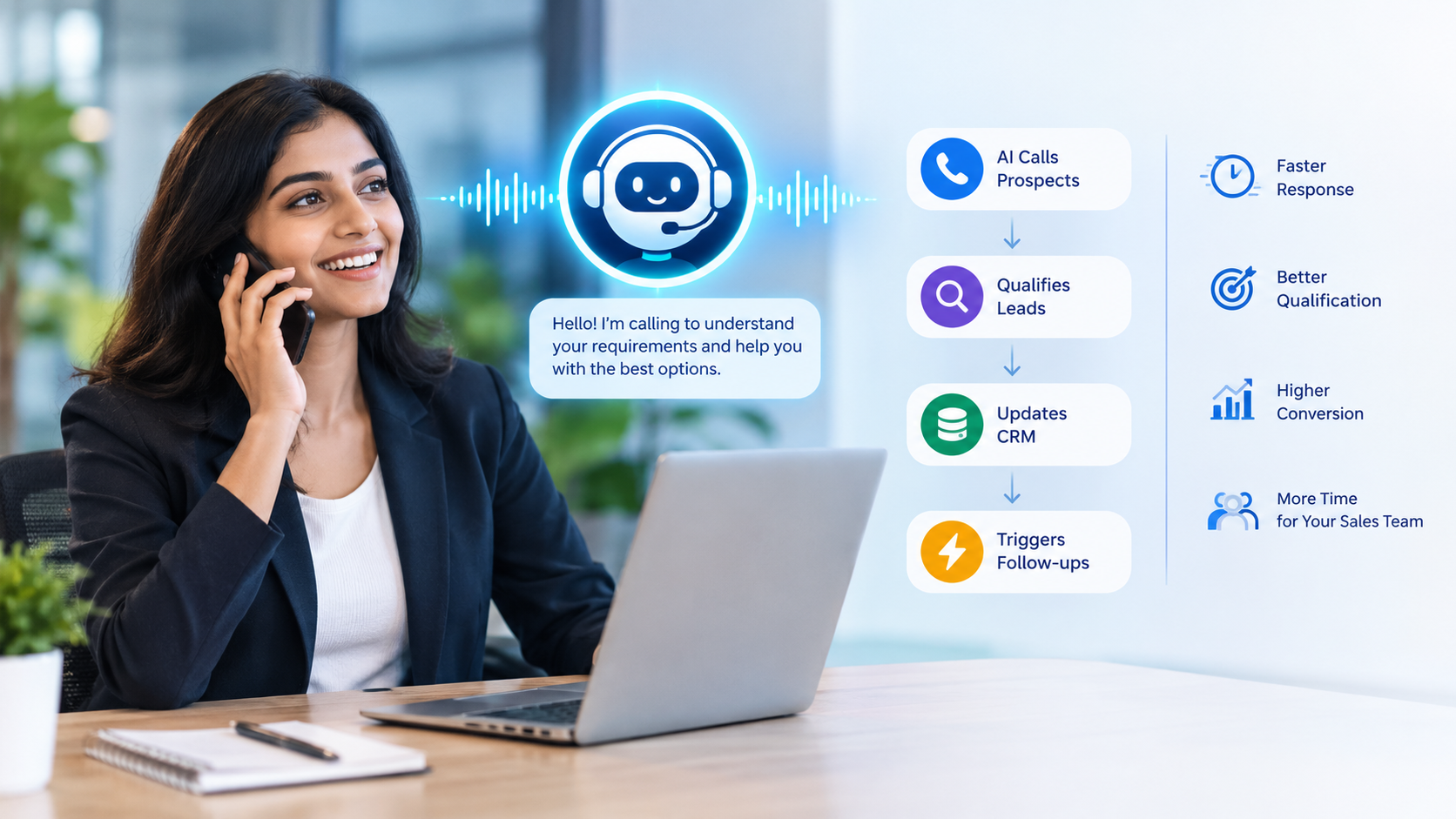
Sales teams often receive more leads than they can call quickly. Some prospects are contacted too late, while others consume valuable sales time without having a genuine buying requirement. This is where AI calling for sales can make a major difference.
AI voice agents can speak with prospects, ask qualifying questions, understand responses, identify buying intent, and pass relevant information to sales teams. Instead of making representatives manually call every lead, businesses can use AI to handle the initial qualification process and allow salespeople to focus on high-value conversations.
For growing businesses, this approach can improve response speed, reduce repetitive calling work, and create a more organised sales pipeline.
What Is AI Calling for Sales?
AI calling for sales is the use of artificial intelligence and voice technology to automatically make or answer sales calls, communicate with prospects, qualify leads, and trigger follow-up actions.
Unlike traditional automated calls that depend on fixed menus or prerecorded messages, AI voice agents can understand natural language and respond based on the conversation.
A typical AI sales calling workflow can include:
- Receiving or identifying a new lead
- Calling the lead automatically
- Asking relevant qualification questions
- Understanding the prospect's responses
- Identifying buying intent
- Recording important information
- Scoring or categorising the lead
- Updating the CRM
- Routing qualified leads to sales representatives
- Scheduling follow-ups or meetings
Modern AI voice technology is increasingly being used for lead qualification, appointment booking, customer engagement and sales workflows.
How Do AI Voice Agents Qualify Sales Leads?
AI voice agents qualify sales leads by following a predefined qualification process, asking questions, interpreting responses, and identifying whether a prospect meets the business's sales criteria.
For example, an AI voice agent for a real estate company could ask:
- What type of property are you looking for?
- Which location do you prefer?
- What is your approximate budget?
- When are you planning to purchase?
- Would you like to schedule a site visit?
The AI can analyse the responses and determine whether the prospect should be treated as a high-priority, medium-priority or low-priority lead.
This gives sales representatives useful information before they begin a conversation.
Why Is AI Calling Important for Sales Teams?
AI calling helps sales teams respond faster, handle larger lead volumes, and spend more time on prospects that are more likely to convert.
One of the biggest challenges in sales is the gap between lead generation and lead follow-up. A prospect may submit an enquiry while a sales representative is busy with another call. By the time the representative responds, the prospect may have already contacted another business.
AI calling helps reduce this delay by allowing businesses to engage leads quickly.
For example, instead of waiting for a salesperson to manually review and call every new enquiry, an AI voice agent can initiate the first conversation and collect basic qualification information.
This creates a faster speed-to-lead process while reducing repetitive work for sales teams.
What Questions Can an AI Voice Agent Ask?
An AI voice agent can ask questions based on the company's qualification criteria, such as budget, requirements, location, timeline, company size, product interest and purchase intent.
The questions depend on the industry and sales process.
For a B2B company, the conversation may focus on:
- Business requirements
- Number of employees
- Current software
- Budget
- Decision-making timeline
- Specific problems the company wants to solve
For a real estate business, the agent may ask about:
- Property type
- Preferred location
- Budget
- Purchase timeline
- Financing requirements
For an education business, it could ask about:
- Course interest
- Qualification
- Preferred course
- Location
- Admission timeline
The important point is that qualification should be based on business-defined criteria, not simply on whether a person says they are interested.
How Does AI Calling Improve Lead Qualification?
AI calling improves lead qualification by applying a consistent process to every conversation and capturing important information automatically.
Human sales representatives may approach qualification differently depending on workload, experience or available time. AI can follow the same qualification framework across large volumes of leads.
This can help businesses:
- Contact more leads
- Reduce repetitive calls
- Standardise qualification questions
- Capture structured lead information
- Prioritise high-intent prospects
- Reduce manual CRM data entry
- Improve follow-up consistency
OrbitoCRM's AI ecosystem is designed around this type of workflow. Its AI Agents page describes automated lead qualification, pipeline routing, predictive deal scoring and automated follow-ups.
Can AI Voice Agents Update a CRM Automatically?
Yes, AI voice agents can connect the conversation with CRM workflows so that call information, outcomes and qualification data can be recorded against the lead.
This is important because making the call is only one part of the sales process.
If the conversation is not recorded, sales representatives may still need to manually enter notes, update lead stages and remember follow-up actions.
A connected AI calling workflow can instead turn the conversation into structured CRM information.
For example:
New Lead → AI Call → Qualification → Lead Score → CRM Update → Sales Assignment → Follow-Up
OrbitoCRM specifically states that its AI calling workflow can turn calls into CRM data, including transcripts, lead scores and outcomes.
You can explore the platform's AI capabilities on the OrbitoCRM AI Agents page.
What Are the Benefits of AI Calling for Sales?
The main benefits of AI calling for sales include faster lead response, consistent qualification, higher calling capacity, automated data capture and better sales-team productivity.
1. Faster response to new leads
Speed matters when prospects are actively comparing businesses. AI can engage leads without requiring a salesperson to manually initiate every first call.
2. More consistent qualification
An AI voice agent can follow the same qualification criteria across conversations, helping sales teams maintain a standard process.
3. Less repetitive work
Sales representatives can spend less time asking basic qualification questions and more time handling product discussions, negotiations and closing conversations.
4. Better CRM data
Automatically capturing call outcomes and qualification information can reduce the amount of manual data entry required from sales teams.
5. Easier lead prioritisation
Once leads are qualified, businesses can focus sales attention on prospects that meet their criteria.
6. Automated follow-ups
AI-driven workflows can help businesses maintain contact with prospects instead of relying entirely on manual reminders.
OrbitoCRM combines AI calling with CRM updates and automated follow-up actions, creating a connected workflow rather than treating calling as a standalone activity.
Is AI Calling Better Than Traditional Sales Calling?
AI calling is not necessarily a replacement for human sales representatives; it is most useful when it handles repetitive, high-volume activities while humans manage complex sales conversations.
AI can be particularly useful for:
- Initial lead qualification
- Basic product enquiries
- Lead follow-ups
- Appointment reminders
- Meeting scheduling
- Re-engaging older leads
- Collecting basic customer information
Human representatives remain important for activities requiring judgement, negotiation, relationship building or detailed product discussions.
A practical sales model is therefore:
AI handles repetitive first-level conversations → qualified leads reach sales representatives → humans focus on conversion.
This hybrid approach allows businesses to increase calling capacity without removing the human element from important customer interactions.
How Can Businesses Use AI Calling Across Industries?
Businesses in industries with high lead volumes and repetitive qualification processes can benefit from AI calling.
Real Estate
AI can ask prospects about property preferences, budget, location and purchase timelines before assigning qualified enquiries to property consultants.
Education
AI can contact course enquiries, understand student requirements, collect basic information and help admissions teams prioritise interested candidates.
Financial Services
AI can perform initial information gathering and qualification before routing appropriate prospects to trained representatives.
SaaS and B2B
AI can qualify businesses based on company size, requirements, existing software, budget and purchase timelines.
Healthcare
For suitable administrative use cases, AI voice agents can assist with appointment-related communication and basic enquiry handling while sensitive or complex matters remain with human professionals.
What Should Businesses Consider Before Using AI Voice Agents?
Businesses should define clear qualification rules, create appropriate conversation flows, monitor call quality, protect customer information and establish when a conversation should be transferred to a human.
Before implementing AI calling software, consider:
- What type of leads should the AI contact?
- Which questions should it ask?
- What makes a lead qualified?
- When should a lead be transferred to a salesperson?
- What information should be stored in the CRM?
- How should unsuccessful calls be handled?
- How will call quality be monitored?
- How will customer consent and applicable communication requirements be handled?
AI should support a well-designed sales process rather than simply automate a poorly defined one.
For additional background on how AI voice agents can handle lead qualification, appointment setting and sales routing, see this AI Voice Agents guide from Salesforce.
How Does OrbitoCRM Support AI Calling for Sales?
OrbitoCRM combines AI calling with CRM, lead management and automated follow-up workflows so businesses can manage the lead journey from initial conversation to sales action.
According to OrbitoCRM, its AI calling system can answer leads instantly, qualify conversations in Hindi, Hinglish or English, update CRM records and automatically follow up. The platform also provides lead scoring, pipeline management and sales automation capabilities.
This connected approach is useful because sales teams do not simply need an AI caller. They need the information generated by the call to become part of their sales workflow.
Businesses can explore OrbitoCRM's product suite to understand how CRM, AI calling, automation and analytics work together.
What Is the Future of AI Calling for Sales?
The future of AI calling is moving toward intelligent sales workflows where AI can engage prospects, qualify conversations, update CRM records, recommend next actions and hand high-intent opportunities to human representatives.
As AI voice technology improves, businesses can move beyond simple automated calls toward more contextual conversations.
The goal should not be to make every sales conversation fully automated. Instead, businesses can use AI to remove repetitive work and help salespeople spend more time where human judgement creates the most value.
For growing companies, this can turn the phone from a manual sales workload into a connected part of the CRM process.
Conclusion
AI calling for sales is becoming a practical way for businesses to handle lead qualification, follow-ups and repetitive sales conversations at scale.
The biggest advantage is not simply making more calls. It is connecting those conversations to the rest of the sales process.
When an AI voice agent can contact a new lead, ask the right questions, identify intent, record the outcome and pass qualified prospects to sales representatives, businesses can create a faster and more organised lead management process.
For businesses looking to combine AI voice agents, CRM, lead qualification and automated follow-ups, OrbitoCRM provides an integrated approach designed to keep every lead and sales action connected.
Frequently Asked Questions
1. What is AI calling for sales?
AI calling for sales uses artificial intelligence to conduct phone conversations with prospects, qualify leads, collect information and trigger sales workflows.
2. Can AI voice agents qualify leads?
Yes. AI voice agents can ask predefined qualification questions, understand responses and categorise prospects according to business-defined criteria.
3. Can AI calling update CRM records?
Yes. When integrated with a CRM, AI calling workflows can record conversation information, outcomes, scores and follow-up requirements.
4. Can AI voice agents replace sales representatives?
AI voice agents are better viewed as sales assistants for repetitive and high-volume tasks. Human representatives remain important for complex conversations, negotiation and closing.
5. Is AI calling useful for small businesses?
Yes. Small businesses can use AI calling to respond to more leads without requiring salespeople to manually make every initial qualification call.